



Rank Math setup
- Focus keyword:
wordpress support ireland - SEO title:
WordPress Support Ireland: When to DIY and When to Hire Help - Permalink:
https://wpmaintain.ie/wordpress-support-ireland-diy-vs-hire-help/ - Meta description:
A practical guide to WordPress support in Ireland, including what business owners can handle themselves, when expert help makes sense, and how to avoid expensive website mistakes. - Pillar content:
No - Schema type:
Article - Article type:
Blog Post - Canonical URL:
https://wpmaintain.ie/wordpress-support-ireland-diy-vs-hire-help/ - OpenGraph title:
WordPress Support Ireland: DIY or Hire Help? - OpenGraph description:
When should an Irish business owner handle WordPress tasks themselves, and when is expert support the better option? - Twitter title:
WordPress Support Ireland: DIY or Hire Help? - Twitter description:
Some WordPress jobs are safe to handle yourself. Others are cheaper to outsource before they become serious problems.
Rank Math FAQ candidates
- What WordPress tasks can a business owner do themselves?
- When should I hire WordPress support in Ireland?
- Is it cheaper to fix WordPress problems myself?
- What should a WordPress support service include?
Featured image package
- Main featured image:
content-drafts/assets/wordpress-support-ireland-diy-vs-hire-help-featured-1600x900.png - Social square image:
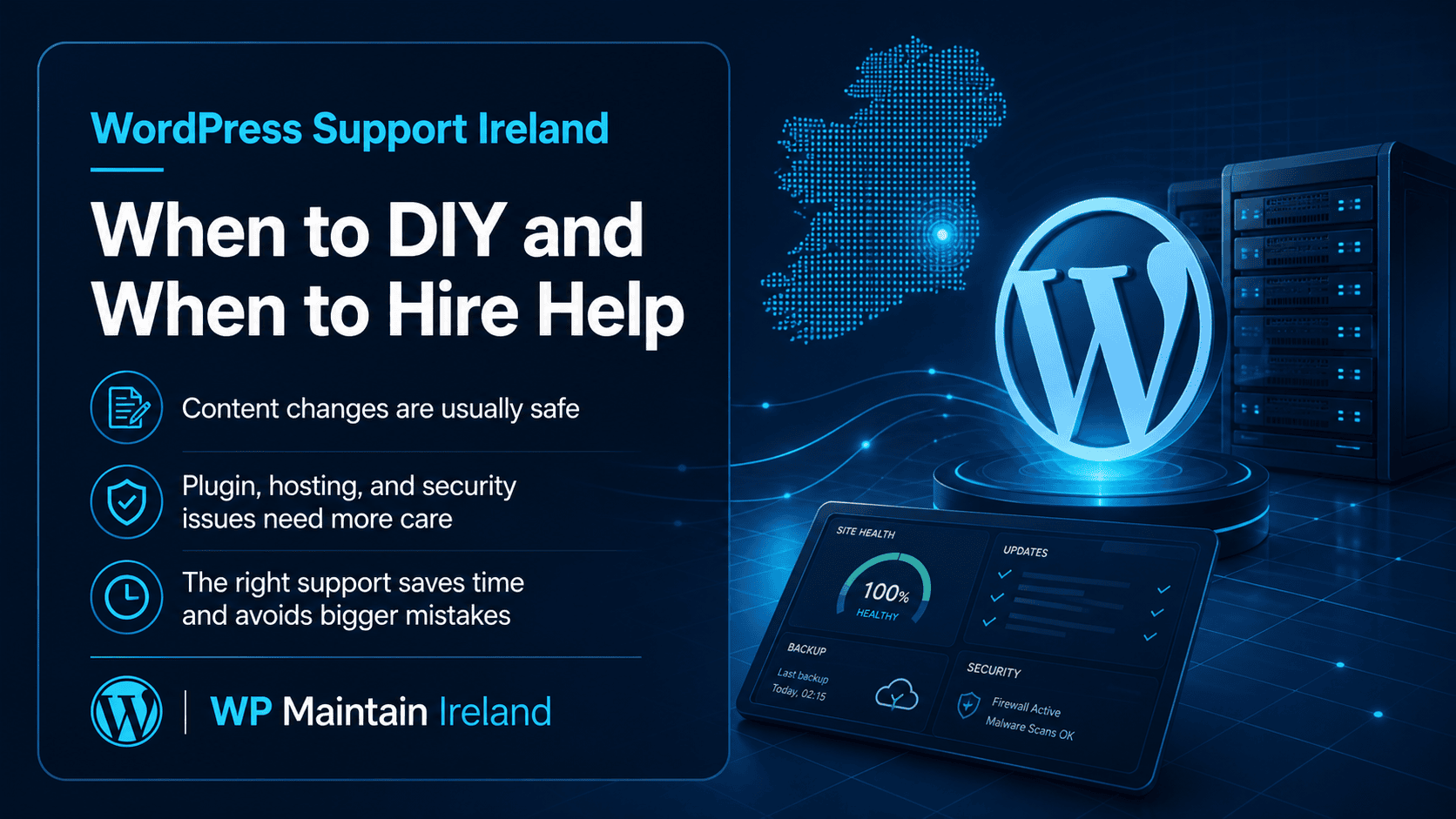
content-drafts/assets/wordpress-support-ireland-diy-vs-hire-help-social-1080x1080.png - Verified overlay lines:
Content changes are usually safePlugin, hosting, and security issues need more careThe right support saves time and avoids bigger mistakes- Overlay source: article body below
WordPress Support Ireland: When to DIY and When to Hire Help
If you run a small business website, there is a good chance you have asked yourself some version of the same question.
Should I try to fix this myself, or should I get proper WordPress support?
That question matters because WordPress can feel deceptively manageable. A lot of day-to-day tasks really are simple enough to handle in-house. But the line between a quick update and an expensive mistake is not always obvious.
That is why WordPress support in Ireland is not just about having someone available when the site breaks. It is about knowing which jobs are safe to do yourself, which jobs should be handled more carefully, and when outside help actually saves time, money, and stress.
If your website already feels harder to manage than it should, you can book a consultation or review our WordPress maintenance support options.
Why the DIY versus support question matters
For many business owners, the website sits in an awkward middle ground.
It is important enough to affect enquiries, bookings, sales, and trust, but it is often still treated like something that can be managed casually in spare moments.
That is usually where problems start.
A simple content edit can be fine. A plugin conflict, broken checkout, failed backup, hacked login, or badly handled update is a different kind of problem entirely.
The real issue is not whether you can log in and change something. It is whether you can do it confidently, safely, and with a clear recovery path if something goes wrong.
What most business owners can realistically do themselves
There are plenty of WordPress tasks that are reasonable to handle in-house.
Safe DIY tasks
- updating page text or images
- publishing blog posts
- changing opening hours or contact details
- reviewing form submissions
- moderating comments
- adding straightforward new pages using an existing layout
These are usually low-risk jobs, especially if:
- the site is backed up properly
- there is a clear process for changes
- the person making the edit understands the basics of the site
For many businesses, this is the ideal setup. You stay in control of everyday content while the more technical work is handled elsewhere.
What often looks simple but is not
This is the part that catches people out.
Some WordPress tasks look easy because the button is visible. That does not mean the impact is small.
Higher-risk tasks
- bulk plugin updates
- theme changes
- WooCommerce settings changes
- form replacement or payment changes
- speed optimisation work
- user access changes
- malware cleanup
- hosting migration
- database or backup restoration
These are the kinds of jobs where a site can appear fine at first and then fail somewhere important later.
That could mean:
- forms stop sending emails
- a checkout process breaks
- mobile layouts shift
- custom functionality disappears
- a backup turns out to be incomplete
This is also where the cost of DIY tends to be misjudged. The issue is not just whether you can attempt the fix. It is whether you can spot the hidden damage afterwards.
When DIY is usually the right choice
Doing it yourself makes sense when the task is low-risk, well understood, and easy to reverse.
DIY is often reasonable if:
- the task is content-only
- the website has dependable backups
- the site is relatively simple
- the person making changes knows the dashboard well
- there is no major risk to leads, sales, or customer access
In those cases, there is no need to overcomplicate things. A business should not have to outsource every small website change.
The best support arrangements usually leave room for sensible in-house updates.
When it is smarter to hire help
WordPress support becomes the better option when the website matters enough that failure has a real business cost.
That is usually the case if:
- the site generates leads consistently
- customers book or buy online
- the site has custom forms or integrations
- updates have been delayed because nobody wants to break anything
- the site has already had security or performance issues
- nobody is fully sure how the site is set up
At that point, outside support is not really a luxury. It is operational protection.
If your site is an important business asset, the question changes from “Can I do this myself?” to “Is this a sensible risk to take?”
Common scenarios where expert support is worth it
1. The site has become slow or unreliable
If the site is loading badly, timing out, or failing in inconsistent ways, the problem is usually broader than one setting.
That could involve:
- hosting limitations
- plugin bloat
- image issues
- caching problems
- database overhead
- outdated PHP or server settings
If that sounds familiar, our article on why your WordPress website is slow is a useful starting point.
2. Updates feel risky
When a business starts avoiding updates because something might break, that is usually the point where support becomes valuable.
It is often a sign that the site needs:
- safer update handling
- clearer rollback options
- staging for testing
- someone who understands how the parts of the site interact
If your site is growing, our guide on whether small Irish businesses really need a staging site is a good companion read.
3. Something security-related happens
If the site is hacked, redirecting, blacklisted, or showing suspicious behaviour, this is usually not the moment for trial-and-error fixes.
Security issues need containment, cleanup, access review, and a proper look at what allowed the issue in the first place.
Our guide on what to do in the first 24 hours after a hacked WordPress site is designed for that situation.
4. WooCommerce is involved
Once ecommerce is part of the site, the stakes are higher.
Changing the wrong setting or updating the wrong plugin at the wrong time can affect:
- checkout
- shipping logic
- payment gateways
- customer notifications
- product display
That is one of the clearest points where support often becomes cheaper than mistakes.
The hidden cost of “just trying something”
Most WordPress mistakes are not dramatic in the moment.
They are usually small, quiet, and expensive later.
That might mean:
- a contact form silently stops working
- Google sees downtime you did not notice
- a plugin update breaks mobile layout
- a backup is unusable when you finally need it
- an old admin account stays active for too long
This is why WordPress support in Ireland is often about prevention as much as fixing things.
A good support process reduces the chance that small issues become expensive business problems.
What good WordPress support should actually include
Not all support is equally useful.
For most Irish small businesses, good support should mean more than “email us if something breaks.
It should usually include:
- safe update handling
- backup awareness and recovery support
- uptime and issue monitoring
- help when forms, pages, or functionality fail
- access control and admin review
- practical advice when the site is changing
If you want a fuller breakdown, our article on what WordPress maintenance includes covers that in more detail.
DIY versus support is not an either-or decision
This is one of the biggest misconceptions.
Most businesses do not need to choose between:
- doing everything themselves
- handing over everything completely
The more useful model is usually shared responsibility.
That means:
- your team handles normal content changes
- a support partner handles technical risk, updates, fixes, and recovery
That approach keeps the site manageable without leaving important technical decisions to chance.
How to decide what category your website falls into
Ask yourself a few simple questions:
Low-risk website
- Would a short outage be annoying but manageable?
- Is the site mostly static?
- Are there no important transactions or lead paths?
- Can content changes be reversed easily?
If yes, you can probably handle more yourself.
Higher-risk website
- Would downtime cost you leads, trust, or revenue?
- Are enquiries or sales dependent on the website?
- Is the site using multiple plugins, forms, or custom features?
- Are updates already being delayed out of caution?
If yes, reliable support usually makes sense.
Where WP Maintain fits
WP Maintain is already positioned around practical WordPress help for Irish businesses, including maintenance, hosting, development, and support.
That matters because most business owners do not just need a one-off fix. They need clarity around who handles what and what happens when something goes wrong.
For many businesses, the most helpful setup is:
- content edits stay simple
- technical work is handled properly
- the site is monitored and maintained before issues stack up
That is usually a better long-term model than waiting until the website becomes stressful.
You can test your site speed with Google PageSpeed Insights, which is a useful starting point for identifying performance issues. Google also explains Core Web Vitals, which help show how speed and usability affect page experience.Final thoughts
Some WordPress jobs are absolutely fine to handle yourself.
Others only look simple until they affect forms, sales, security, or the overall stability of the site.
The smart decision is not always to outsource everything. It is to know where the real risk starts.
If your website matters to your business, proper WordPress support in Ireland is often less about dependency and more about avoiding avoidable problems.
If you want help deciding what should stay in-house and what is better supported professionally, you can book a consultation or review our WordPress maintenance support options.
Frequently asked questions
What WordPress tasks can I safely do myself?
Content edits, blog publishing, image updates, and straightforward page changes are usually safe if the site is backed up properly and you understand the dashboard.
When should I hire WordPress support in Ireland?
You should usually get support when the site affects leads, bookings, sales, security, or when updates and fixes feel risky to handle without expert help.
Is it cheaper to fix WordPress issues myself?
Sometimes, for small low-risk tasks. But for technical issues, slow websites, plugin conflicts, security problems, or WooCommerce issues, DIY can become more expensive if the problem gets worse or important parts of the site stop working.
What should a WordPress support service include?
At a minimum, safer updates, backup awareness, help with technical issues, monitoring, and practical support when key parts of the website fail.